Quick answer
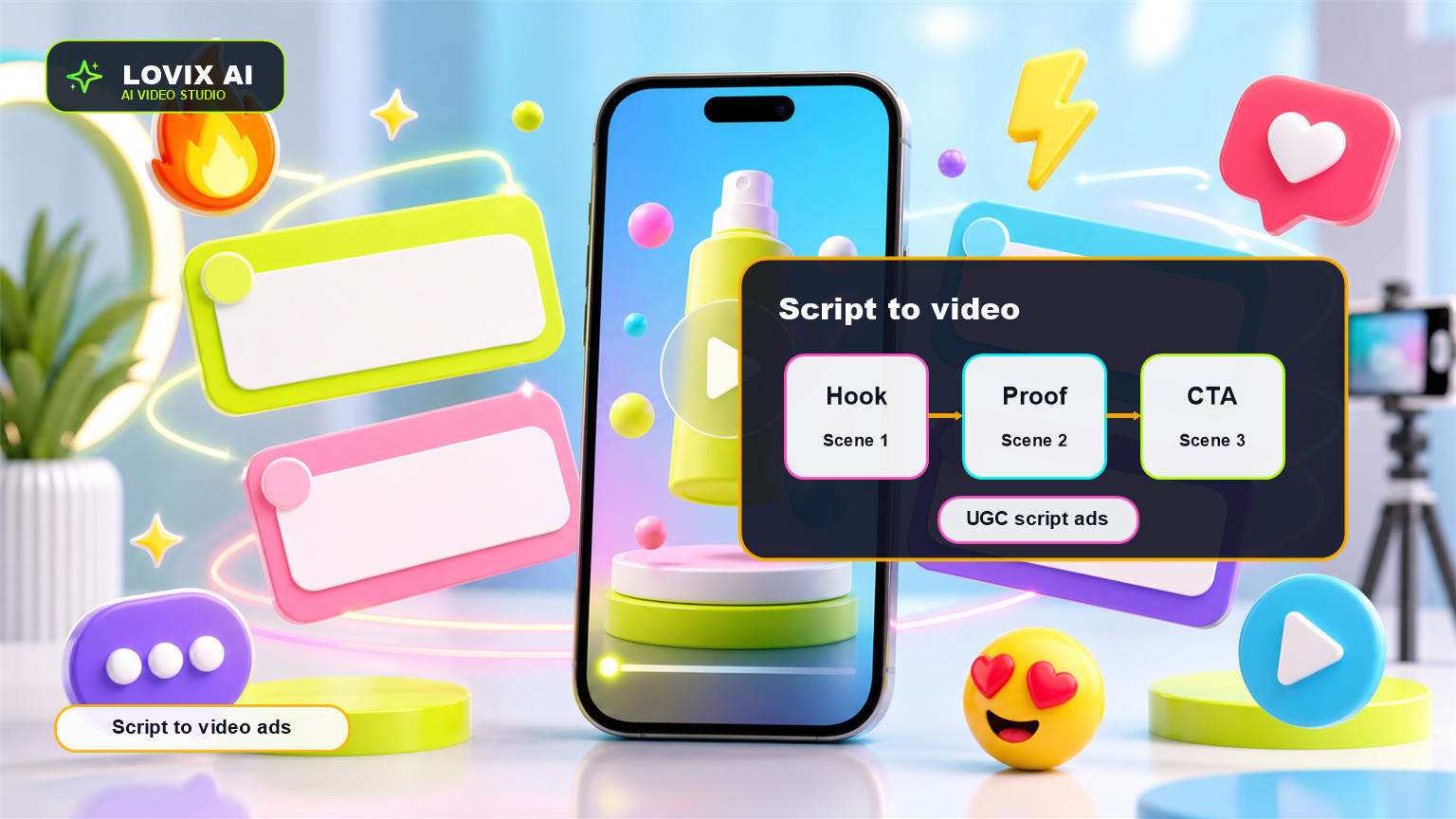
Script to video AI turns a written ad script into generated video scenes. LOVIX AI can use hooks, creator lines, product proof, scene direction and CTA structure to create UGC AI ads, product videos and social video variants from a campaign script.
A good AI video ad usually starts as a good script. The script does not need to be long, but it needs a hook, a visual proof moment and a reason for the viewer to act.
What Script To Video AI Means
Script to video AI uses written ad structure as the foundation for a generated video. The script can include dialogue, scene notes, product action, camera direction, offer language and CTA.
For marketing teams, this is useful because scripts already contain the thinking behind the ad. A strong hook, objection, proof point and CTA can become a video without starting from a blank prompt.
LOVIX AI works best when the script is paired with visual direction. The tool needs to know not only what is said, but what the viewer sees while it is said.
Build The Script Around A Hook
The first line decides whether the ad earns attention. For UGC AI, the hook should sound like a creator talking to a real person. For product video AI, the hook can be visual: a close-up reveal, before-and-after or surprising use case.
Strong hooks are specific. 'This changed everything' is weak. 'This fixed the one thing I hated about packing skincare for travel' gives the viewer a concrete reason to continue.
Write several hook options before generating. LOVIX AI can help turn each hook into a separate video variant.
- Problem hook: names a pain.
- Curiosity hook: opens a loop.
- Result hook: shows a payoff.
- Objection hook: addresses doubt.
- Founder hook: explains why the product exists.
Pair Every Line With A Visual
A script is not enough if the visuals are generic. Every important line should have a visual counterpart. If the line says 'it fits in my bag', the video should show the product fitting in the bag. If the line says 'the texture is lighter', show texture.
This is where many AI video prompts fail. They include spoken claims but forget the proof. Script to video AI works better when dialogue and product action move together.
Use a simple table while planning: line, scene, product action, camera move and final frame.
Write UGC AI Dialogue Like A Creator
UGC AI dialogue should sound natural. Avoid long feature lists, corporate adjectives and polished brand slogans. A creator line should feel like a person explaining why the product mattered in a specific moment.
Examples: 'I bought this for one trip and now it lives in my bag.' 'I thought it was just packaging, but the cap is actually the best part.' 'If your desk gets messy by lunch, this makes the reset way easier.'
Short lines also help lip sync and pacing. One or two spoken lines are often enough for an 8-second ad.
Use Product Proof As The Middle
The middle of the script should show proof. This could be a hand demo, close-up texture, before-and-after, comparison, unboxing, product fit, app screen or result moment.
Proof is what separates a persuasive AI video ad from a nice-looking clip. The viewer should understand at least one practical reason to want the product.
End With A Clear CTA
A CTA does not need to be loud. It needs to be specific. 'Shop the bundle', 'Try it before your next trip', 'Create your first video with LOVIX AI' and 'Use it in your next campaign' are clearer than 'Learn more'.
For script to video AI, the CTA can be spoken, visual or both. A clean final hero frame with product visible can carry the action even without heavy on-screen text.
Script To Video Prompt Template
Use this in LOVIX AI: 'Script to video AI ad, vertical 9:16, 10 seconds. Product from Image 1 remains accurate. Hook line: [line]. Scene 1: [visual]. Scene 2: [product proof]. Scene 3: [CTA moment]. Creator delivery is natural and conversational. Camera is handheld with close product framing. No fake captions, no distorted logo, no extra products.'
For product-only ads, replace creator delivery with camera direction: macro push-in, slow orbit, close-up demonstration and final hero frame.
Turn One Script Into Five Variants
A script is a creative system, not a single asset. Keep the product proof stable and test five hook variants. Or keep the hook stable and test five creator personas. This is how LOVIX AI becomes useful for paid social testing instead of only one-off video generation.
Track which script angle creates the clearest first second, best product visibility and strongest CTA frame. Those are the outputs most likely to become usable campaign creative.
FAQ
What is script to video AI?
Script to video AI turns written hooks, scene notes, dialogue and CTA structure into generated video scenes.
Can LOVIX AI create ads from a script?
Yes. LOVIX AI can use a written script, product reference and scene direction to generate AI video ads and UGC AI variants.
How long should an AI video ad script be?
For short social ads, one hook, one proof moment and one CTA are usually enough. Eight to twelve seconds should stay focused.
Turn a script into an AI video ad
Use LOVIX AI to transform hooks, product proof and CTA structure into script to video AI campaign creative.
Sign up for LOVIX AI